
Your Medical Records Are Doing More Work Than You Think
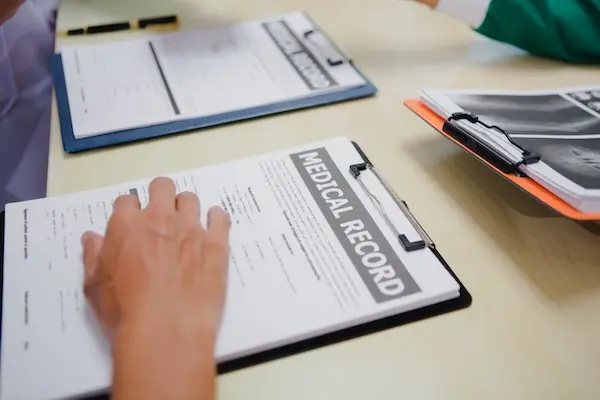
When people think about building a personal injury claim, they usually picture photographs of the accident scene, a police report, maybe a witness statement or two. Medical records rarely make that mental list, but they’re arguably the single most important piece of evidence in the entire case. Everything else helps establish who caused the accident. Your medical records are what prove what it actually did to you, and without that connection, even the clearest liability case can fall apart.
This piece walks through why these records carry so much weight, what a strong medical record actually looks like, and the mistakes that quietly undercut a claim before anyone realizes what’s happening. For a broader look at the process overall, see our guide on the essential steps to filing a personal injury claim.
Why Adjusters Care So Much About Paper
An insurance adjuster wasn’t at the scene of your accident. They didn’t see the impact, and they don’t know how you felt the next morning. What they have instead is a file, and inside that file, your medical records are the closest thing to an objective account of what happened to your body. A treating physician’s notes, written in real time by someone with no financial stake in your case, carry credibility that your own recollection simply can’t match on its own.
This is exactly why adjusters comb through medical records looking for anything that creates doubt: a gap between the accident date and your first visit, a pre-existing condition that overlaps with your current symptoms, or a chart note that doesn’t quite match what you told your lawyer happened. None of these things necessarily mean your injury isn’t real, but they give the other side a foothold to argue that it is.
What Actually Counts as a Strong Medical Record
Not all documentation carries the same weight. A complete, well-supported claim usually draws from several categories:
- Emergency treatment records — the ER or urgent care visit immediately after the incident, which establishes the earliest, most contemporaneous account of your injuries
- Diagnostic imaging — X-rays, MRIs, and CT scans that provide objective, visual confirmation of an injury rather than relying on subjective pain reports alone
- Specialist referrals and consultation notes — records from orthopedists, neurologists, or other specialists your treating doctor referred you to
- Physical therapy and rehabilitation records — these document not just that you’re in pain, but how that pain is affecting your function and recovery over time
- Prescription records — a documented history of pain medication, muscle relaxers, or other treatment tied directly to the injury
- Follow-up and discharge notes — records showing whether your condition improved, plateaued, or worsened, which matters enormously when valuing future care
Each of these serves a slightly different purpose, but together they build a timeline that’s very difficult for an adjuster to argue with.
The Danger of Waiting to Seek Treatment
A delay between the accident and your first medical visit is one of the most common things adjusters use to devalue a claim. Even a gap of a few days can be enough for the other side to argue that something else caused your injury, or that it simply wasn’t serious enough to warrant immediate attention. This is particularly damaging with injuries like concussions, soft-tissue damage, or spinal issues, conditions that don’t always announce themselves with a visible wound but absolutely show up in symptoms if you’re paying attention.
The Danger of Stopping Treatment Too Early
The opposite problem is just as common. Once the acute pain fades or finances get tight, people sometimes stop going to appointments, even when their doctor recommended ongoing care. Unfortunately, a treatment gap reads to an adjuster as a sign that you’d recovered, whether or not that was actually true. If you later need to resume care because symptoms return, reestablishing that connection to the original accident becomes much harder.

Future Treatment Needs Deserve Documentation Too
A personal injury settlement isn’t just about the bills you’ve already paid, it’s supposed to account for what you’ll still need. If your doctor anticipates future surgery, ongoing physical therapy, or long-term pain management, that expectation needs to be documented, ideally through a written medical opinion rather than just a passing verbal comment during an appointment. Without that kind of record, an adjuster has little reason to include future costs in a settlement offer at all.
How a Personal Injury Lawyer Uses These Records
Gathering medical records isn’t just a matter of requesting a stack of paperwork. A personal injury lawyer reviews them closely to connect your current condition to the accident, identify any gaps or inconsistencies before the other side does, and, when needed, work with medical providers to clarify future treatment needs. That work is what turns a pile of records into a demand that accurately reflects what the injury has actually cost you, and what it’s likely to cost going forward.
One practical note: when you request your own records, most providers will ask you to sign a HIPAA authorization form. The U.S. Department of Health and Human Services maintains official guidance on your rights to access your own medical records if you want to understand that process directly.
Why Choose H Groves Law
Led by trial attorney J. Harmon Groves, H Groves Law represents injured clients throughout Georgia and South Carolina on a contingency fee basis, so you pay no attorney’s fee unless we recover compensation for you. We handle the evidence, the documentation, and the conversations with adjusters so nothing gets overlooked while you focus on your recovery.
Contact H Groves Law for a Free Personal Injury Consultation
If you’re not sure whether your medical documentation is strong enough to support your claim, that’s a conversation worth having sooner rather than later. Contact H Groves Law today for a free, no-obligation case review, or visit our personal injury page to learn more about how we build cases for injured clients throughout Georgia and South Carolina. Call (770) 329-9981 to speak with a personal injury lawyer about your case.